The Fair Isle knit, a two-ply knitting tradition with roots tracing back to the coasts of Scotland, has transcended time and space to become a wardrobe essential for over a century. This heritage pattern has kept everyone from 18th-century fishermen to rock legends like Mick Jagger cozy and stylish. In recent years, high-end fashion houses such as Ralph Lauren, Thom Browne, Chanel, Celine, Balenciaga, Raf Simons, Versace, and Dries van Noten have showcased their interpretations of this classic knit on the runways. London-based designer Molly Goddard has made the Fair Isle pattern a hallmark of her brand, consistently pairing structured Fair Isle knits with voluminous tulle skirts in her collections. The Fair Isle knit has solidified its status as a winter staple that remains perennially fashionable.
Celebrities like Adam Brody, who donned a red and white Fair Isle sweater on the cover of Stylist magazine, and Katie Holmes, spotted wearing a vintage beige Fair Isle sweater while running errands, have also embraced the trend. The Fair Isle knit is a seasonal favorite in the northern hemisphere, worn from the first chill of autumn until the last days of sweater weather. Even in the climate-defying city of Los Angeles, stars like Hailey Bieber have been seen enjoying the comfort of Fair Isle knits over coffee.
The name "Fair Isle" is derived from the island itself, part of the Shetland archipelago located approximately 100 miles off the northeastern coast of Scotland. This knitting technique originated in the 18th and 19th centuries, initially in fishermen's hats, which were designed to be both artistic and functional. The double-strand pattern not only created an aesthetically pleasing design but also provided extra warmth by increasing the fabric's thickness. These hats often included a knitted interior lining for added insulation.
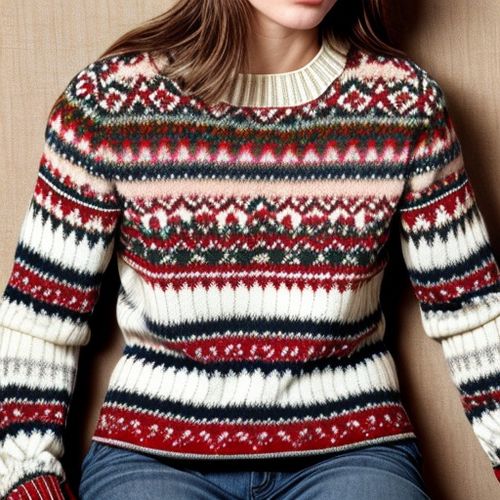
The quintessential Fair Isle knit follows an 'OXO' pattern, alternating geometric 'O' shapes with 'X' shapes across the garment. Some knitters embellish the 'O' with symbols like crosses, snowflakes, or a central dot known as a "goose's eye." What set these apart from other fishing attire was their vibrant color palette, featuring blue, red, yellow, natural white, and a natural brown referred to as Shetland black, as explained by Dr. Carol Christiansen, curator and community museums officer at the Shetland Textile Museum. The bright colors were intentional, making skippers more visible from land or other boats.
The transformation of this functional workwear into a fashion staple began when it became a popular tourist item. In the 19th century, fishermen from Norway and the Netherlands visited Shetland to catch herring, a lucrative summer activity. The colorful hats of the Fair Isle workers were seen as charming novelties and perfect souvenirs for the Dutch fishermen to take home. By 1870, Shetland had established regular boat and postal services, which boosted trade and tourism. The island soon became a holiday destination for hunters and bird watchers, who, like the Dutch skippers, could bring a piece of Fair Isle back with them. As demand grew, the trade expanded to include stockings, gloves, scarves, and eventually, pullovers.
The Fair Isle pattern's popularity skyrocketed in the 1920s when a portrait of Prince Edward by Sir Henry Lander in 1923 reinforced its association with sportsmanship. Depicted on the golf course in a subdued Fair Isle V-neck and tartan flat cap, the British royal helped propel the style into the mainstream. This coincided with a shift in women's fashion, as looser, more comfortable garments replaced the restrictive corsets and petticoats, thanks to designers like Paul Poiret and Gabrielle Chanel (who was herself a fan of Fair Isle, photographed in a collared cardigan with the distinctive 'OXO' pattern in 1910). Women began wearing similar cardigans, pullovers, and pleated knee-length skirts, often knitted by themselves if couture was unaffordable. Fair Isle quickly became a symbol of family, as it was a staple in women's knitting pattern books in the 1940s and 50s. Mothers across the UK would knit Fair Isle pieces for themselves, their husbands, and their children, using the leftover yarn, dressing entire nuclear families in matching Fair Isle, symbolizing tradition, convention, and wholesome living—a visual shorthand that modern designers still employ to evoke nostalgia.
"Anything with a sense of place and time gives people a sense of belonging," said senior knitwear designer Emma Brooks for British label Toast in a Zoom interview. Fair Isle knits are a consistent feature in the brand's Fall-Winter collections, partnering with a specialist factory in Scotland (though not in Shetland) and often collaborating with local Scottish yarn spinners. "There's something about a knitted jumper and a motif around the yoke that is flattering. It's a pop of color without being too overwhelming, which I think taps into a lot of people's way of dressing."
While the design has never been officially trademarked, the traditional Fair Isle possesses a heritage quality that is challenging to replicate, though many attempt to do so. In 2015, Chanel rekindled their connection with the pattern in a Metier d'Arts collection in Rome, which was dedicated to celebrating the craftsmanship of their ateliers. The knits sparked controversy when independent Shetland label Mati Ventrillon claimed Chanel had copied her designs after the fashion house visited her studio for research. Chanel apologized and credited Ventrillon in subsequent marketing materials promoting the show.
Brooks is acutely aware of the cultural sensitivity surrounding the craft and even visited Dr. Christiansen at the Shetland Textile Museum in 2019 to seek design inspiration for Toast's next collection, made with Shetland yarn. "It's important to be sensitive to the fact that certain motifs are very traditional from a particular regional area," said Brooks. "What surprised me about the Shetland Textile archive was the breadth in terms of color palettes. I was expecting more muted colors because of what you see in historical books of Fair Isle, but there was a real expanse, and a sense of designs changing over time, with knitters mixing tradition with completely different styles."
Today, Dr. Christiansen believes that trademarking the craft of Fair Isle is nearly impossible. "There have been attempts, but it's difficult since we never got as far as place designation," she said. There are also complications with cattle breeding, meaning not all Fair Isle knits created on Shetland are made with wool from Shetland sheep. "It gets really complicated," she said. "It's a pity because now it's probably too late. Fair Isle is being produced all over the world. That's just how it is, it's global fashion."

By Jessica Lee/Feb 26, 2025
By Sarah Davis/Feb 26, 2025

By James Moore/Feb 26, 2025
By Noah Bell/Feb 26, 2025

By Noah Bell/Feb 26, 2025
By Daniel Scott/Feb 26, 2025

By Ryan Martin/Feb 26, 2025

By Victoria Gonzalez/Feb 26, 2025
By Benjamin Evans/Feb 26, 2025
By Lily Simpson/Feb 26, 2025

By Christopher Harris/Dec 25, 2024

By Christopher Harris/Dec 25, 2024
By Daniel Scott/Dec 25, 2024

By Elizabeth Taylor/Dec 25, 2024
By Daniel Scott/Dec 25, 2024
By Emily Johnson/Dec 25, 2024

By Michael Brown/Dec 22, 2024