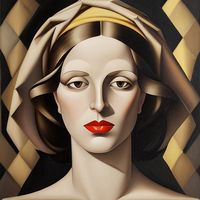
Polish artist Tamara de Lempicka, renowned for her vibrant portraits of women with scarlet lips, has become an enduring symbol of the Art Deco era, even after her passing in 1980. Her creations, characterized by their rich, jewel-like hues and sculptural quality, evoke a sense of longing as her subjects stand against cityscapes or drive automobiles, with their garments and scarves dramatically fluttering in the wind. Although Lempicka did not consistently receive critical acclaim during her lifetime, her works are now highly sought after and are part of the collections of celebrities like Barbra Streisand and Madonna, who showcased some of Lempicka's art during her "Celebration" tour.
The value of Lempicka's paintings has skyrocketed over the years, with a piece depicting cabaret singer Marjorie Ferry reaching £16.3 million ($21.3 million) at auction in 2020, setting a new record for the artist. A century after the peak of her career, Lempicka's life and art continue to captivate the art world. Until recently, Lempicka had not been the subject of a major retrospective in the United States, but a new exhibition at the de Young, part of the Fine Arts Museums of San Francisco, is set to display over 150 of her pieces, offering a comprehensive look at her artistic journey.
"She embodied the optimism that swept Europe as it recovered from the First World War," curator Furio Rinaldi explained in a conversation, noting the hope for a future where women's roles were redefined and they entered the workforce in unprecedented numbers. "Fashion evolved to accommodate their newfound mobility and self-expression, and Lempicka encapsulated the spirit of this new woman: liberated, sexually empowered, and financially self-sufficient." However, Rinaldi pointed out that Lempicka's contributions have often been oversimplified. "She's often seen as an Art Deco figure, associated with decoration and fashion, but she was so much more. She was an exceptionally talented painter, arguably among the finest of her time."
Lempicka was born into affluence in Poland at the tail end of the 19th century, though the exact location of her birth remains a mystery. She later settled in St. Petersburg but was compelled to flee during the Russian Revolution, eventually arriving in Paris in 1919. There, she developed a unique style by blending various influences, including Russian avant-garde, cubist flatness, the elegance of fashion and advertising, and the composition and form of Italian Renaissance and French Neoclassical painters. Despite her aristocratic background, Lempicka was often marginalized by major art movements and was even dubbed the "Baroness with a Brush" in a 1941 publication.
Today, staging a comprehensive exhibition of Lempicka's work is challenging, as most of her pieces are in private hands and frequently change ownership, Rinaldi noted. "This has significantly impacted her critical reception, as she's not well-represented in museums and is not widely recognized as part of the artistic canon," he said. In 2021, the de Young acquired a Lempicka drawing, a 1937 study of a young girl with ringlets and arched eyebrows, making it the first institution in the country to purchase her work. Three years later, the de Young's curators have assembled a comprehensive exhibition featuring rarely and never-before-seen pieces, uncovering new information about the enigmatic artist, who was known for obscuring or embellishing details about her life and for her flair for dramatic self-promotion.
Streisand, who wrote the opening essay for the exhibition catalog, described Lempicka as a woman who "navigated the highest circles of society with ease—a cool, glamorous blonde shrouded in mystery, with lovers of both sexes." Rinaldi highlighted her adept use of media, noting, "She sometimes lied about certain aspects. She once introduced her daughter as her younger sister—sometimes trivial things, sometimes more serious. It certainly shows a woman fully in control of her life and identity, carefully crafting her own persona." Some of Lempicka's fabrications were strategic, such as her claim to have arrived in New York on the day of the 1929 stock market crash, which she did not, or her Polish Catholic identity, which concealed her likely Jewish heritage.
In the "Tamara de Lempicka" exhibition, curators reveal her birth name, Tamara Rosa Hurwitz, for the first time, and update her birth year to 1894, earlier than Lempicka had claimed, based on findings by Polish historian Andrzej Slowicki. The exhibition also features new works, including the 1928 painting "Spring," depicting two women in an intimate moment with one whispering to the other while holding small white flowers. The show spans Lempicka's early Russian folkloric-influenced works from the 1920s to her signature sultry nudes and modern aristocratic portraits, and the quieter tabletop scenes she painted during World War II.
It includes the self-portrait that first caught Streisand's attention in 1979, showing Lempicka driving a green Bugatti with a fixed gaze on the viewer. Lempicka had her first solo show in Paris in 1930 and regularly exhibited around the city in the early years of her career. However, her style did not align with the prevailing Surrealism or Abstract Expressionism of the time, Rinaldi noted. "As a defensive reaction, she returned to an extreme appreciation for the Old Masters, creating religious scenes and simple still lifes." The only group she fully embraced was The Society of Modern Women Artists in Paris, advocating for equal representation of women in art and hosting an annual salon in which she participated throughout the 1930s.
When she returned to the US in 1939, just before the outbreak of war in Europe, she exhibited at Pittsburgh's Carnegie Institute. Later, she and her second husband, Baron Kuffner, funded a traveling exhibition in New York, San Francisco, and Milwaukee with the renowned art dealer Julien Levy—eight of the twelve works from this original San Francisco stop are displayed in a recreated room in the de Young exhibition. In the 1940s, Lempicka's work was featured in a book for the first time, coinciding with an exhibition in Rome. However, until the final years of her life, when there was a scholarly resurgence of interest in the Art Deco period, her work remained largely unappreciated, and she considered her style to be "out of fashion," according to the de Young's catalog.
Although Lempicka's art is now back in vogue and has garnered sustained interest for decades, Rinaldi believes there is still much scholarly and curatorial work to be done to uncover her secrets. "We're really just scratching the surface of what can be done, what can be discovered about her," he said. The de Young exhibition is a testament to the enduring appeal and significance of Lempicka's art, offering a rare opportunity for the public to delve into the life and work of this enigmatic artist who defied the conventions of her time and left an indelible mark on the art world.

By Jessica Lee/Feb 26, 2025
By Sarah Davis/Feb 26, 2025

By James Moore/Feb 26, 2025

By Noah Bell/Feb 26, 2025

By Noah Bell/Feb 26, 2025

By Daniel Scott/Feb 26, 2025

By Ryan Martin/Feb 26, 2025

By Victoria Gonzalez/Feb 26, 2025

By Benjamin Evans/Feb 26, 2025
By Lily Simpson/Feb 26, 2025

By Christopher Harris/Dec 25, 2024

By Christopher Harris/Dec 25, 2024
By Daniel Scott/Dec 25, 2024

By Elizabeth Taylor/Dec 25, 2024

By Daniel Scott/Dec 25, 2024
By Emily Johnson/Dec 25, 2024
By Michael Brown/Dec 22, 2024